 Shu-Hu
Evolutionary Mechanisms in nearby galaxies: Insights from Statistical Analysis of Observations and Cosmological Simulations
Hassen Yesuf (SHAO), 2024-4-24
Informal talk
https://astro.tsinghua.edu.cn/info/1101/2816.htm
energy & momentum input from active black holes & supernovae are important for galaxy evolution.
Star-forming galaxy power spectra -> galaxy properties (SFR, metallicity, dust content, etc.)
AGN (active galactic nuclei) spectra -> whether or not 'high-acceration' black hole
- related to which side do you observe the AGN.
SED fitting
measure gas mass from dust
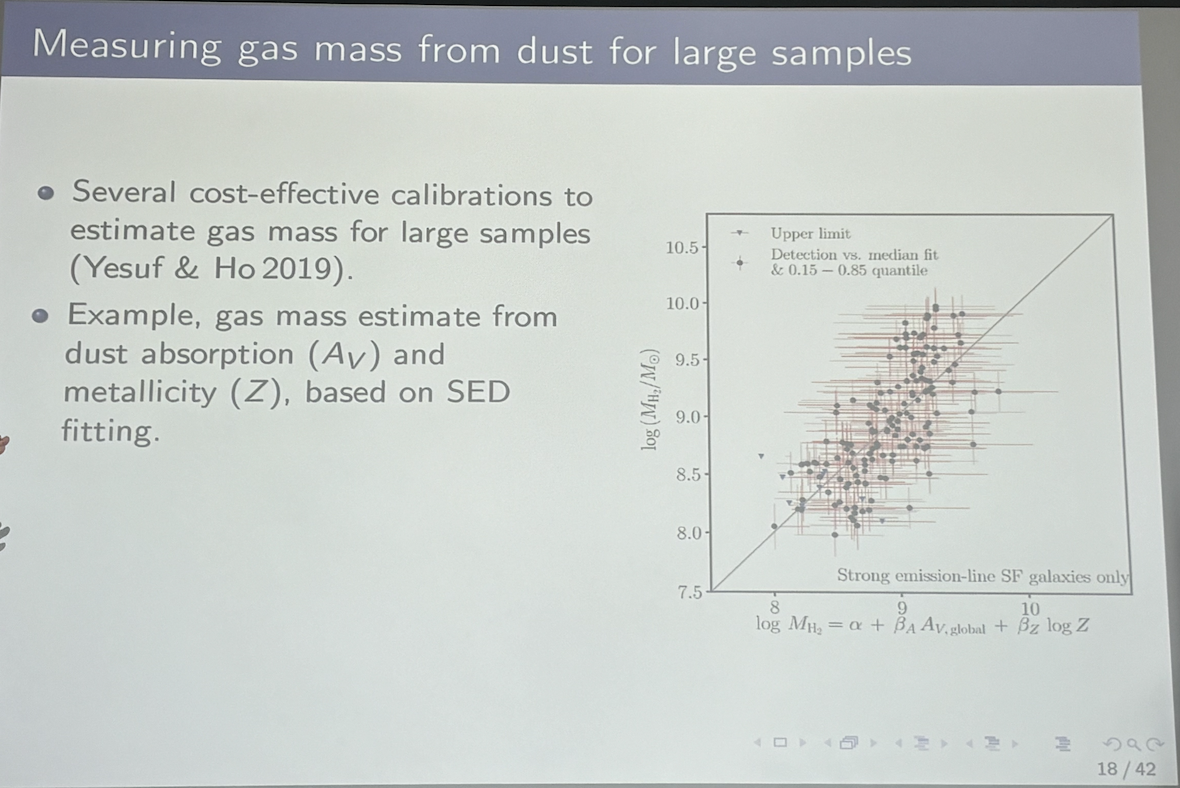
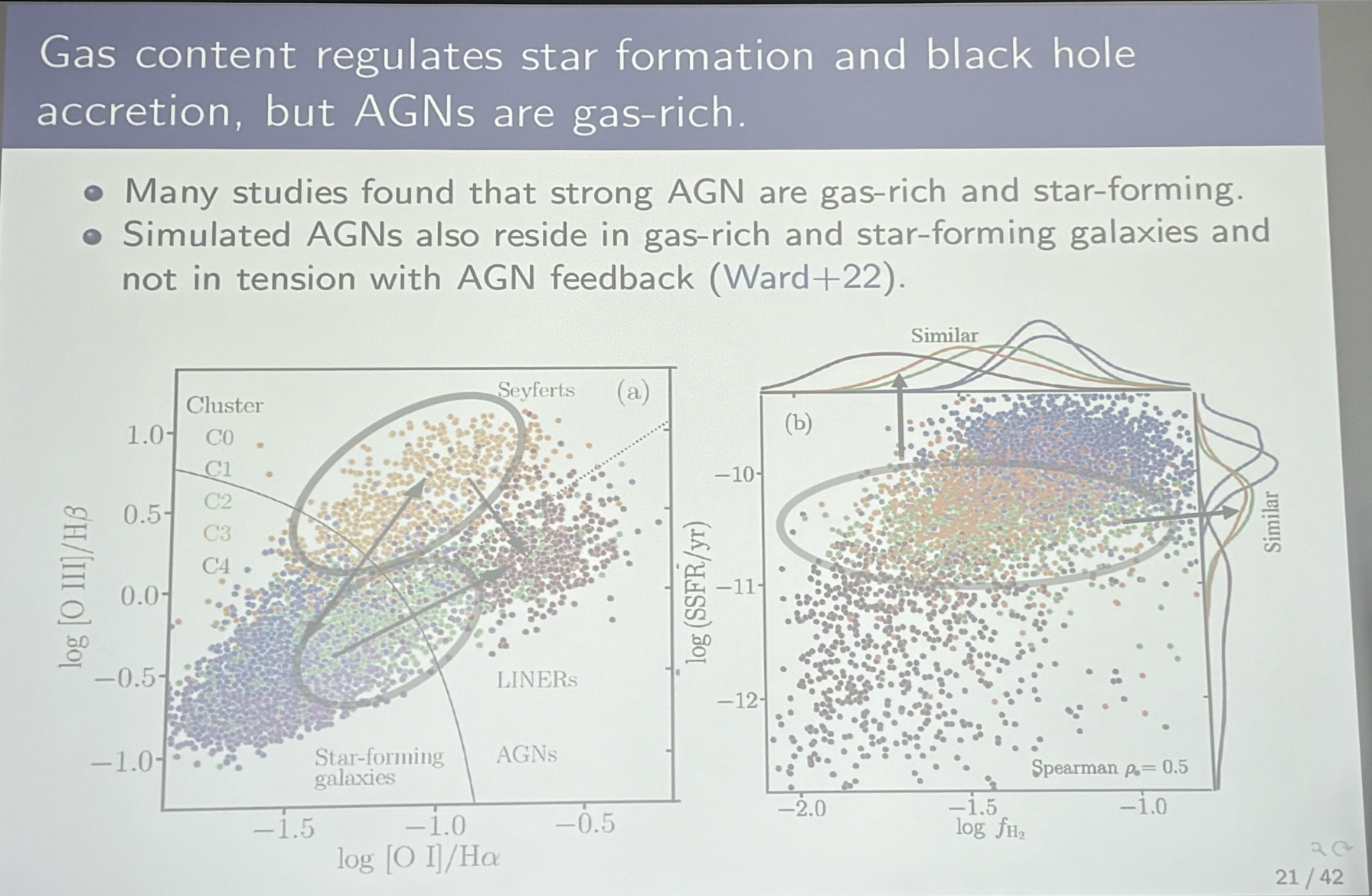
==find:== most nearby (z<0.35) AGN hosts are NOT gas-poor.
many AGN hosts are still in star-forming, not quenched or green valley.
2 components are actually 'same':
......
- quantify enviroment with galaxy stellar mass rather just number density of galaxies.
....
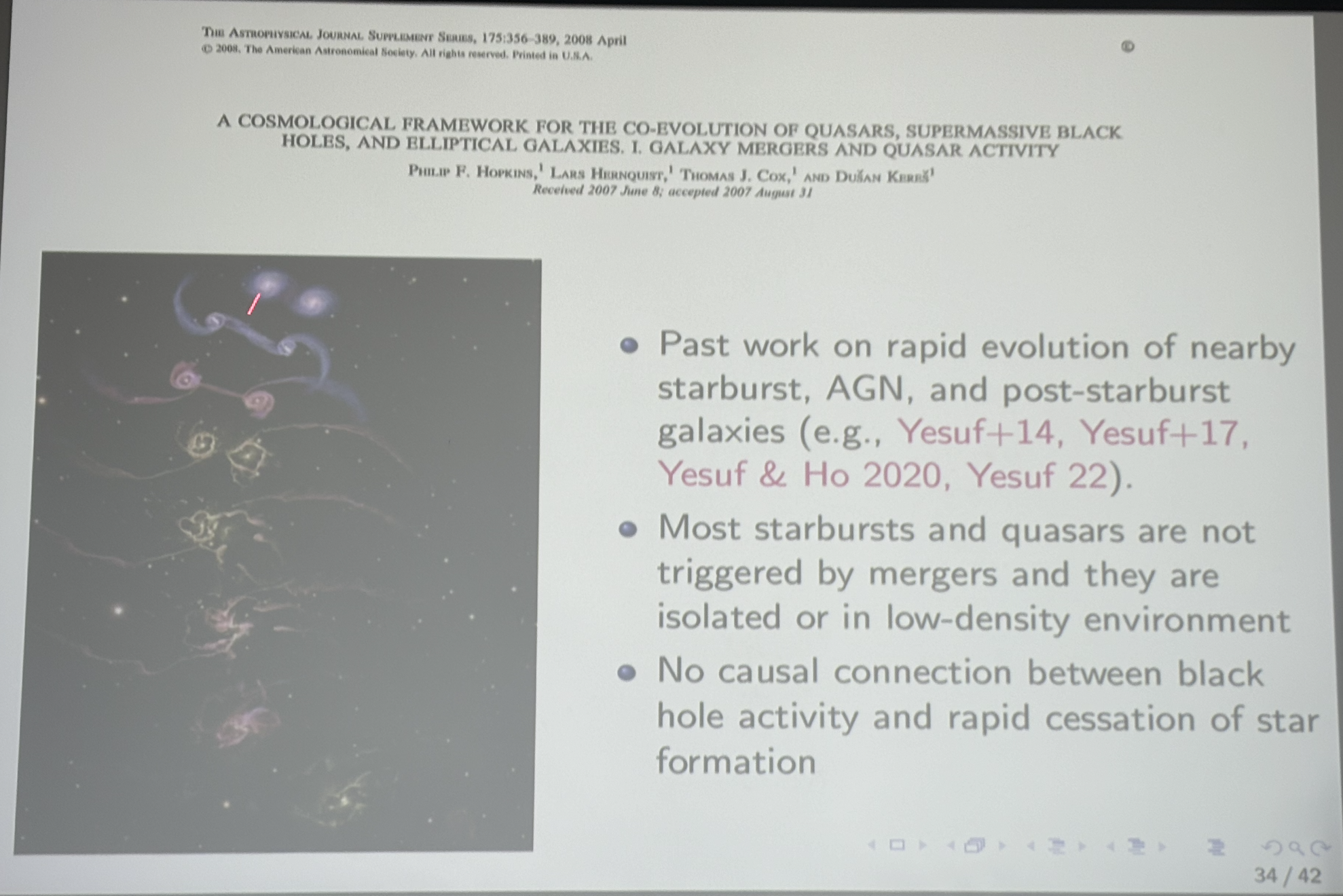
how galaxies evolve from star-forming to quench... Yesuf's works:
future works:
- SFH for low mass galaxies:
- FAST: map the gas around nearby low-mass galaxies, eg. NGC 4713 (17 hrs in 2023)
- indirectly study the impact of gas acceration with metalicity.
- CSST
- stellar mass asymmetry with image survey
- minor mergers, etc.
- ...
- stellar mass asymmetry with image survey
- uprecedented maps of multiphase gas in multiscale environments in near and sitant Universe with SKA, eROSITA, MUST etc.
- SFH for low mass galaxies:
Summary
- Galaxies are complex systems and are influenced by SMBH feedback, gas accretion, mergers, and multiscale environments
- Despite their many merits, current cosmological simulations do not accurately reproduce regularities observed in nearby galaxies.
- The halo-scale environment and related processes influence the availability of cold gas, thus affect both short-term activity and long-term quiescence in galaxies.
- A combination of recent gas accretion, leading to episodic starbursts and black hole activity, alongside ancient bulge buildup, provides a plausible explanation for the structural, spatial, and temporal variations observed in nearby galaxies.
Q&A
大家花了很多时间讨论:为什么大尺度 under dense 的地方 merger rate 反而高。 基本信息有:
- 尺度 cut 是projected的,红移的cut是独立的,但并不影响结果。
- 大尺度 under dense 的地方 merger rate 高,得到了 simulation 和 observation 的一致结果。
- 小尺度 over dense 的地方 merger rate 高,对于simulation来说resolution有困难,observation的结果也不十分可信,因为sample incomplete。
- 至于“大尺度 under dense 的地方 merger rate 反而高”的原因并不很清楚。可能是velocity太大,也可能是在高红移merge过了,可以从数据中研究……
另一个问题是传统上认为非常亮的 AGN 能源来自 merger,现在发现并非如此……